
How to Lead with Values

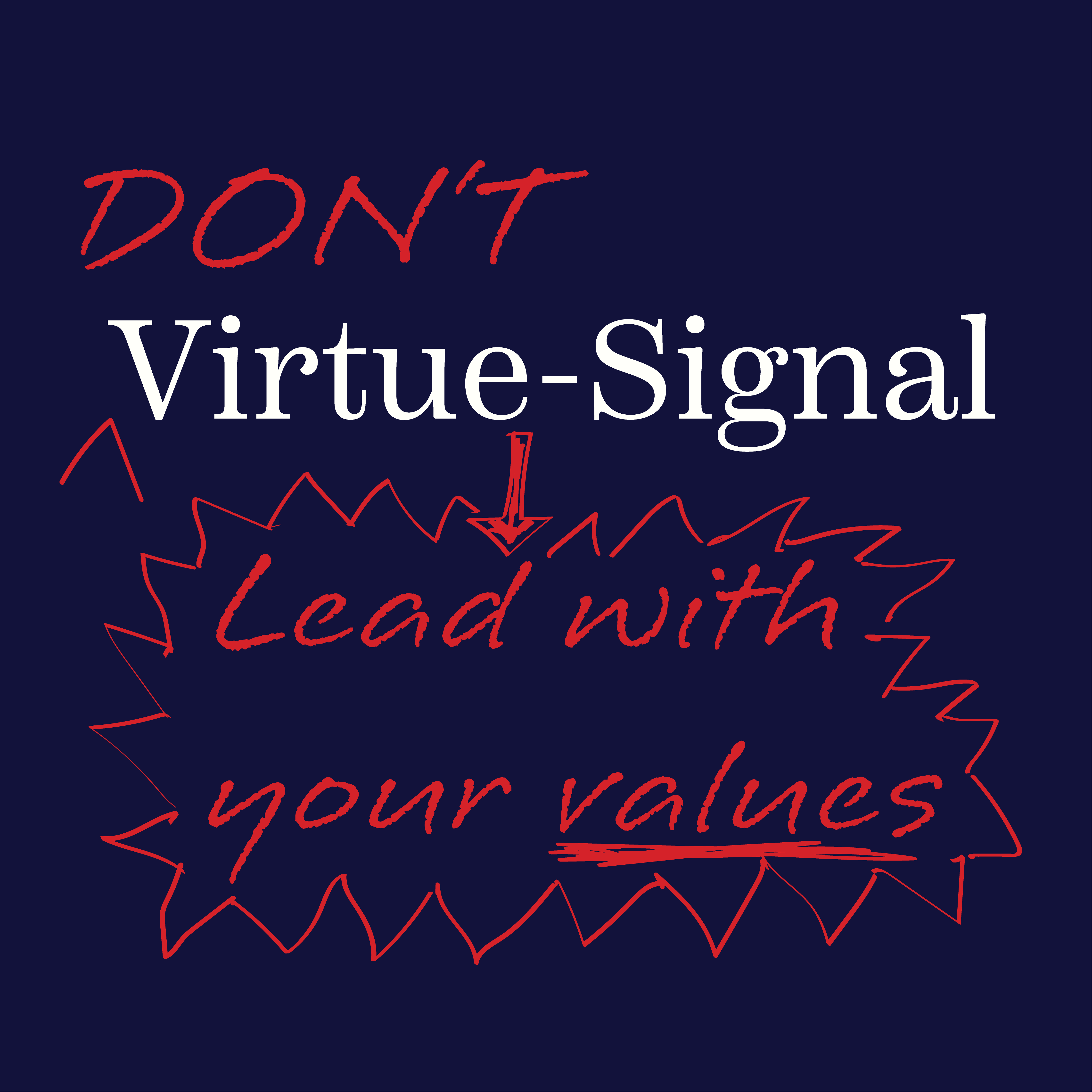
In one of my recent posts, one of the ways I mentioned for working more sustainably was to focus more on leading with values. While this is true and indeed what I’m doing, I didn’t really have the space to do the subject justice.
Values are criminally underrated in marketing and communications, and you can tell in a world filled with brands that virtue-signal, chase memes, and just generally make meaningless noise. We frequently catch brands with “values” that do not align with who they are and what they’re doing.
Many companies don’t truly realize the importance of values (or communications, for that matter), so they’ll pick a list of buzzwords that seem like they’ll be widely attractive/inoffensive, and go on with business as usual. They pick values they think will sell more of their products at the cost of being authentic. Others might have caught onto the idea that a company’s values and its culture are somehow linked (which they are), and create some beautiful prose to stick on their corporate office’s wall, which is where those words will stay. A company’s custom-made Live, Laugh, Love, as it were.
The thing is, leading with values is exactly none of the things I mentioned above. Values sit at the heart of any enterprise and activity, whether you’re selling books or trying to get someone to apply for grant funding. Whether you’re selling a product or service or trying to get people to believe in your startup. When used well, values can shape everything an enterprise or organization stands for, inspire employees, drive impactful communications, and provide a sense of meaning to clients and consumers whenever they interact with your brand.
Maximizing the impact of values can be challenging, though. It requires for a person or enterprise to cut the crap. To walk the walk instead of talking the talk. To choose the things that are worth fighting for and then to fight for them, even when it’s hard. Already, I can see how many people are going to argue with me. “But Misha,” they might say. “I’m running a business here. I want to be attractive to as many people as possible!”
To which I say, “Yes, but keep reading, young grasshopper.”
Let’s take a moment to talk about what values are, and what they’re not.
More than an item on a checklist
Most people encounter the need for values when they’re asked to create a business plan. As a result, it’s common to read values that feel like they were literally written to check an item off a checklist. “XYZ wants my business plan, and the vision, mission, and values are a standard part of it. So I guess I need to figure out the values, huh.” The vision and mission tend to be easy, though. You probably set up a company to follow a specific mission, so it’s easy to imagine where that will get you in five years (i.e. to see what your vision should be).
Perhaps because of that, people approach values the same way. Pick five obvious things and list them, then promptly forget about them. More marketing-orientated people will pick values based on being as inoffensive as possible, or on attracting as wide a group of people as possible. This is not how a brand’s true values come to life, though. Worse still, if you aren’t judicious about what your brand stands for, those values will be picked for you in that infamous marketplace for ideas.
If that isn’t ominous enough, these approaches completely ignore the reason why stakeholders care about values in the first place. If vision is your destination and mission is your vehicle to get there, your values are the road you’ll be taking.
They also serve as a bridge between you and your audience/client base.
Vision says, “This is where I want to be in five years.”
Mission asks, “What am I doing right now to get there?”
Values say, “This is how I am approaching the things I need to do to achieve the vision.”
This how can tell stakeholders (clients, investors, employees, clients, readers, etc.) a lot about who you are as a business, organization, or creator. In fact, I would argue that your values will determine your brand much more than your logo and tagline do. To take it a step further, your values should be what informs at least your tagline, if not your logo as well.
By actively choosing what you stand for, you create a space for your brand in which you can authentically reach out to your audience, with a voice that is unique to your brand. This brings me to what it truly means to lead with values.
The meaning of leading with values
It’s easy to hear the phrase “leading with values” and think that you’re about to go off preaching into the void. Hell no. Trust me when I say, I’m no preacher. Neither does “leading with values” equate to virtue-signaling. It’s exactly the opposite of both things.
Leading with values means putting your brand’s values above all else. And I mean all. That’s where it becomes truly challenging in a world where profits and keeping shareholders happy comes before everything else. Which of course, we can look around at the state we’re in and ask, “how’s that working out for us?”
I believe in stakeholder primacy. For those of you unfamiliar with the difference between stakeholders and shareholders, let me clarify: Shareholders are people who invested money for a shareholding in a business. Stakeholders are all people, enterprises, and organizations with whom an entity’s interests may align, or upon whom an entity’s activities has an impact of any sort.
Shareholders are stakeholders. So are employees, government, and people impacted by your activities. (E.g. if you’re going to open a mine somewhere, the people on and around the land you want to mine are stakeholders too.)
You might be wondering why I bring this up, so I’m going to just come out and say it. If you’re tempted to operate according to different values between your employees, investors, and/or your target clients, you’re doing it wrong. An enterprise’s values should be the through-line that serve as its first principles for operations. If they’re not, you’re virtue-signaling at best. At worst, you’re lying to your stakeholders.
Choose the hill you’re willing to die on...and stand your ground
This seems impossible in a world where we are seemingly validated by likes and shares. The larger the number, the more successful we are, or at least that seems to be the common wisdom. That’s true, I guess, if your aim is to collect likes and shares. Since that tends not to be the case, we have an opportunity to be a bit braver.
The moment your goal is about anything else (profit, selling a book, building a community), the common wisdom of audience growth above all else is, to put a word on it, unwise. Whenever people want to argue with me about that, I ask them this hypothetical question: What’s better? 1,000,000 followers with a 1% conversion rate, or 100,000 community members who will jump on whatever you ask them to do?
You’ll notice the numbers come to the same number of people who do the thing. The latter is what I want, though. I’d rather have slower growth with 100% (or as close to that as possible) of my following being loyal and committed to my brand, than to put in the huge amounts of work (and/or money) to get a huge following, 99% of which will never care enough to respond to my brand’s calls to action.
Leading with values helps you do that. By being clear and overt in standing for something that matters to your brand, you’re allowing your audience to self-select based on whether they care about the same things. To be clear, I don’t (only) mean this politically, and because I’m pointedly trying to get us away from virtue-signaling, we don’t even all have to agree about the relative importance of one type of value over another. If your brand values quality over price and luxury above all else, those values set it apart from the brand that values being eco-friendly most of all. And as I said, leading with values isn’t about being preachy. In terms of communications, neither of these brands are better than the other. (In fact, there might even be significant overlap between how the products are being made or consumed.)
The point is that the primary audience for each brand will be different. If the brands lead from their values, these audience members will be attracted to the brand based on what the company stands for. By choosing a hill that your brand is willing to die for, you’re also making yourself visible as a rallying point around that same hill, not only for your clients but all of your stakeholders. Employees will want to work for a firm that embodies values that are important to them. Investors are more interested in firms with which they have values in common.
Think about this: if you need to enter into a committed relationship with anyone, do you want the person whose personality turns on a dime depending on who is in the room with them, or the person who is honest about who they are and will act consistently according to their values no matter what? Yeah. Business (and communications) works the same way. If you’re in any doubt about that, check how people react to businesses that virtue-signal in a way that isn’t true to their perceived values.
This brings me back to the flip side to leading with values: If you choose your hill, you better be standing on it on all fronts.
Words talk. Actions walk.
It’s on this point where we find the balance between communications/marketing and a company or organization’s culture. If values are only words to signal to potential clients, that will reflect on your company culture. Not only that, but the truth will out, and you’re probably going to find yourself on a hill you didn’t ever want to be on, fending off an onslaught from all sides.
Since I don’t want to comment on specific brands, let’s go back to the examples I shared earlier. If your brand is all about luxury, but you underpay your staff, you’re evoking a very different set of values compared to the one you’ve been broadcasting through your communications. Same (and arguably even worse) if you have a brand that broadcasts values that could be considered “virtuous”, such as being eco-friendly or inclusive. If your brand stands for being eco-friendly and it emerges that you’ve been greenwashing? Prepare for a PR nightmare because the truth will come out.
In short, don’t select values that contradict who you are and what you do as a brand. And don’t do anything that you’re not willing to stand by if people start questioning you about it. For the love of all that is holy, don’t use your communications to create a false impression of who you are.
That’s basically what leading with values means. Knowing who you are as a brand. Being clear and honest about that with all of your stakeholders. There’s no preaching or value-signaling involved. Only being authentic and honest while attracting the people who will care about what you do based on how you do it.
It’s that easy and that hard.
What does your brand stand for? How do your (or your enterprise’s) actions and communications represent your brand’s values? Do you have any questions about branding, communications, and values? Let me know in the comments.